
Seven Ways a Seasonal Sample Round Goes Wrong Before the Bulk Order
By the time a bulk order goes wrong, the cause is usually already in the file: a brief that described a mood, a comparison run under changing conditions, or an approval given by three people to three different vials. None of these mistakes look dramatic at the time. They remove optionality quietly, and a seasonal calendar has very little optionality to spare.
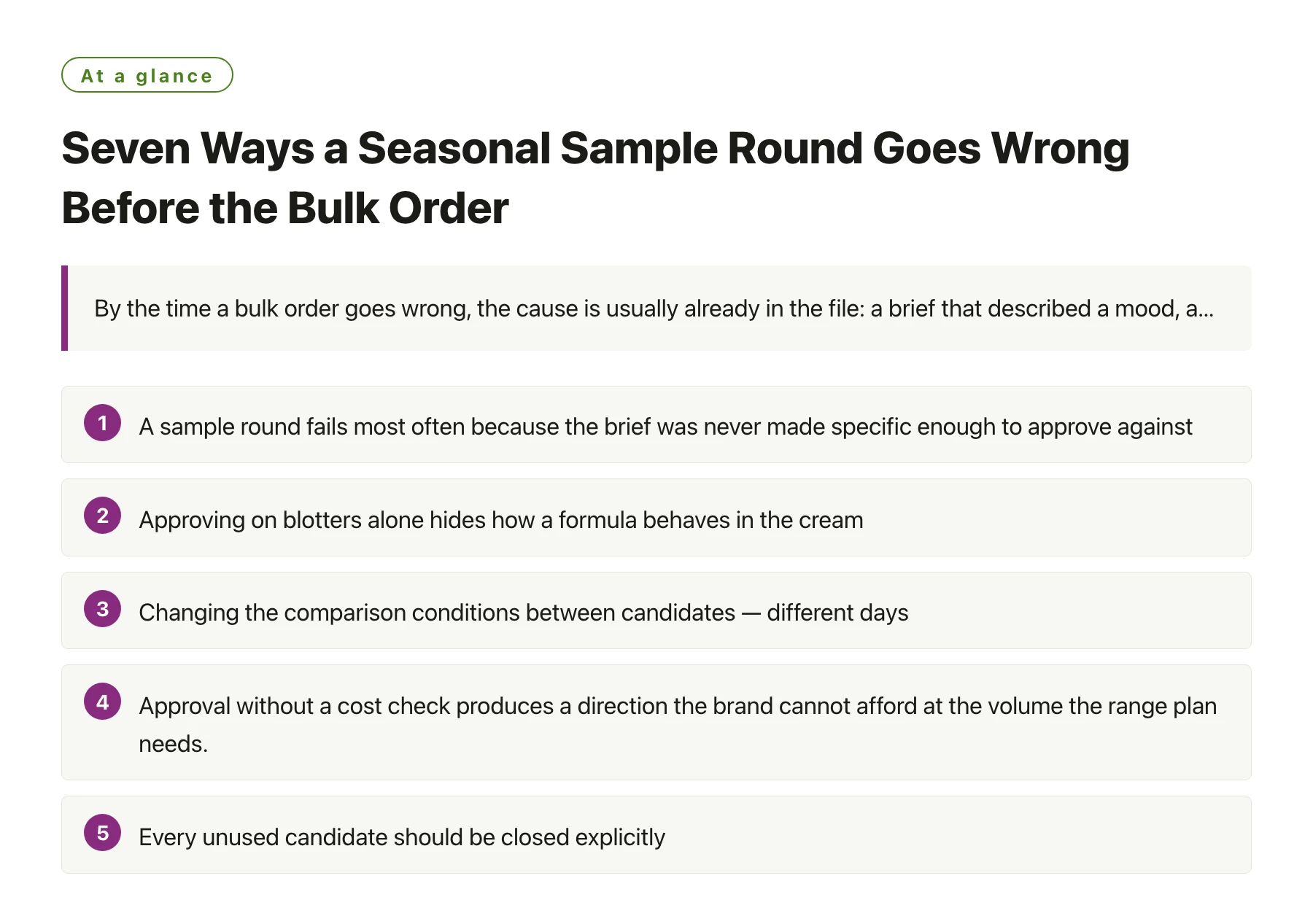
Key takeaways
- A sample round fails most often because the brief was never made specific enough to approve against, not because the lab produced the wrong scent.
- Approving on blotters alone hides how a formula behaves in the cream, wax or wash it will actually be sold in.
- Changing the comparison conditions between candidates — different days, rooms or bases — makes the result unreadable, even when the scents are fine.
- Approval without a cost check produces a direction the brand cannot afford at the volume the range plan needs.
- Every unused candidate should be closed explicitly, because an open vial becomes an open question in month three.
Seasonal work rewards discipline more than it rewards inspiration. The scent still has to be good, but the difference between a launch that lands and one that slips is usually administrative: what was written down, what was compared under the same conditions, and who was allowed to say yes.
The seven mistakes below are drawn from the way seasonal rounds actually collapse. They are ordered roughly by how early they occur, because the earlier a mistake happens, the more it costs to correct.
If you are running a seasonal sample round for the first time, the useful exercise is to read the list against your own plan and count how many you are currently set up to make.
Mistakes in the brief and the first comparison
The first group of failures happens before any sample exists. They are cheap to fix and expensive to inherit, because everything downstream is built on top of them.
A brief that reads like a mood board cannot be approved against anything. If the document says 'warm and elegant, like the mood of the campaign', two people can accept two different vials and both be right. Add the measurable parts: the family, an example of the effect you want, the dosage, the base, the target markets and the unit cost ceiling.
1. Approving a smell instead of a specification
A scent can be approved if the brief states what matters. Start with the opening, the heart and the dry-down described in words, then add the constraints that are not negotiable: dosage, base, restricted-material limits and the price point the range can carry.
Ingredient and allergen language belongs in the brief too. Using the naming conventions of official ingredient inventories avoids a round of translation later, and the European inventory is a practical reference for that vocabulary [1].
2. Sending the same brief to several factories with different scopes
Comparing quotes from partners who were asked different questions produces a comparison that looks quantitative and means nothing. One may have priced the compound only; another may have included filling, decoration and packing.
Fix the scope in the brief, then compare. Documentation is part of that scope, and industry associations publish reference material on how cosmetic products are regulated and recorded, which is a reasonable place to check terminology before you write the tender [2]. If the scope is genuinely unclear, the published manufacturing scope at www.xuelei.com is the kind of page that shows how one supplier separates development, filling and packing, which makes the questions for the others easier to write.
3. Running the comparison under changing conditions
Candidate A is opened on Monday morning in a cold meeting room; candidate B is opened on Friday afternoon after lunch. The two results are not comparable, and no amount of discussion repairs that. Fix the room, the time, the number of blotters and the base before anything is opened.
This is the cheapest mistake to prevent and the one most often repeated, because it does not feel like a mistake while it is happening.
Mistakes at the moment of approval
By the time samples are on the table, the pressure is real and the calendar is visible in the room. That is when the second group of failures appears.
All of them share a shape: a decision is taken that feels final, but there is nothing in writing to make it final. The bulk order then gets judged against interpretation.
4. Letting a committee approve different samples
Three stakeholders smell, three people prefer different directions, and the meeting ends with a vague agreement to 'go warmer'. The next round arrives, and the argument restarts. Name one approval owner, collect the others' input in writing, and let the owner decide.
The approval owner also protects the factory from contradictory instructions, which is a real cost: a manufacturer receiving two change requests in one week will usually pause the project until the brand settles.
5. Approving without the base and the format
A fine fragrance on a blotter and the same compound in a body cream are different products. Materials that dominate in ethanol can disappear in a cream, and a wax can flatten the brightest part of a formula. Approve in the base, at the dosage, in the format you will actually sell.
This matters most in a seasonal drop, where one scent direction is reused across several items. Each base needs a trial, and the trial result is what gets approved, not the abstract scent.
6. Ignoring the cost ceiling until after approval
A direction that is affordable at two thousand units may be impossible at fifteen thousand, and the reverse is also true when a range is planned badly. Ask for the cost picture at the volume the range plan assumes, before the direction is locked, not after.
Where a scent is approved above the ceiling, the usual outcome is a reformulation request late in the round — which costs a sample cycle and reopens the whole discussion.
7. Leaving every candidate open
An unclosed candidate is a standing invitation to reopen the decision. Write one line per vial: chosen, held or stopped, with the reason. Close the round formally, and keep only the approved reference plus anything the brand has a real reason to revisit.
Teams that skip this step are the ones who, two months later, cannot remember whether the version in the drawer was the one they liked.
The mistake underneath all seven is treating the sample round as a creative stage and the production order as the serious part. The opposite is closer to reality: the sample round is where the project is specified, and every ambiguity not resolved there is resolved later at a higher price. A seasonal calendar usually has room for one genuine surprise. Spend it on the scent, not on the paperwork. If the round is being run with a supplier you have not worked with before, walk through the documentation and approval expectations in advance rather than discovering them mid-round.
What to fix first if you recognise yourself here
Start with the brief. If the brief is specific, mistakes three, four and five shrink on their own, because there is a written standard to compare and to approve against. Then fix the record keeping, which is a ten-minute habit rather than a project.
The organisational fixes come next. One approval owner, one scope definition and one cost ceiling, agreed before the first vial is opened, will do more for a seasonal launch than adding another round of samples.
It also helps to see how other projects handled the same decisions. Case write-ups from previous programmes, such as Xuelei, are useful less for the scents shown than for the paperwork described: what was specified, what was tested, and what was signed. Read them for the process, and treat the beautiful photography as a bonus.
For brands that have already decided to buy a developed formula rather than commission one, the same seven mistakes apply with a shorter runway. A ready direction makes private label fragrance production faster, but it does not remove the need to approve in the base, check the cost at volume, and record the decision.
Sources
- EU CosIng — Cosmetic Ingredient Database (European Commission) —— The European Commission's CosIng database of cosmetic ingredients, listing ingredient functions, restrictions and labelling requirements under EU cosmetics law.
- Cosmetics Europe —— The European trade association for the cosmetics and personal care industry, publishing guidance, positions and market information.
Frequently asked questions
How do I write a brief that can actually be approved against?
Include the measurable parts alongside the descriptive ones: fragrance family, dosage, base, target markets, restricted-material limits, unit cost ceiling and the item list for the drop. Then describe the opening, heart and dry-down in words. A brief with both halves gives the perfumer freedom inside a boundary and gives the brand a standard to approve against.
Why does a sample smell different in the finished product?
Because the base changes which materials are perceptible. A cream, a wax and an ethanol spray each hold and release aroma materials differently, and some materials that dominate a blotter are barely noticeable in an emulsion. Always trial the scent in the base it will be sold in.
Should more than one person approve a fragrance sample?
Collect opinions widely and let one person decide. Shared approval authority produces contradictory instructions to the factory and makes it impossible to say later which version was approved.
What should happen to the samples that were not chosen?
Close them explicitly with a one-line reason and keep only the approved reference plus anything you have a real reason to revisit. Open candidates tend to reopen decisions late in the calendar, when reopening is most expensive.
When should the compliance side of a scent be reviewed?
Before the formula is frozen. Restricted-material headroom, allergens that need declaring in the target markets and the label wording should all be checked at approval time, because changing them afterwards means new artwork and, in some markets, a new notification.
— Filed by admin for Avatar Games Hub.