
How Long 0.01 BTC Takes at Four Hashrate Levels
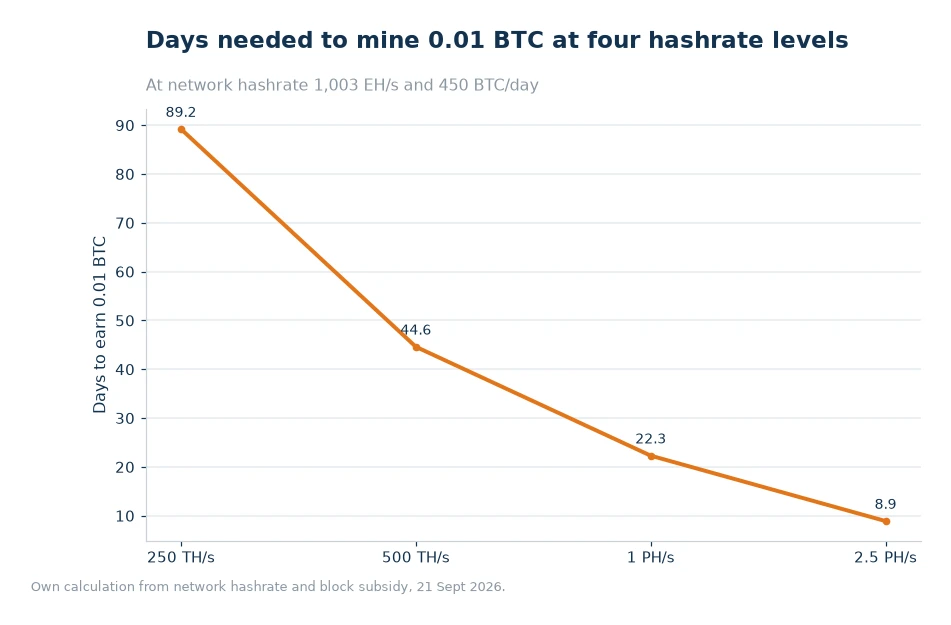
A daily earnings figure is useful, but a target is easier to plan around. At 250 TH/s, current network conditions produce 0.00011215 BTC a day, so 0.01 BTC takes about 89.2 days; double the hashrate and the wait halves to 44.6 days. The same arithmetic at 1 PH/s gives 22.3 days, and at 2.5 PH/s it gives 8.9 days.

Key takeaways
- Daily output per terahash is 4.5e-07 BTC at 1,003 EH/s, so 250 TH/s earns 0.00011215 BTC a day.
- Reaching 0.01 BTC takes 89.2 days at 250 TH/s, 44.6 at 500 TH/s, 22.3 at 1 PH/s and 8.9 at 2.5 PH/s.
- Pool Hashrate sets the size of the shared reward; Pool Luck describes whether blocks arrived faster or slower than expected.
- The next difficulty estimate is minus 2.12%, which would shorten each wait slightly if it holds.
Why the target beats the daily rate
Daily income answers a cash-flow question. A target answers a planning question. If the goal is to accumulate 0.01 BTC before a purchase, the number that matters is the number of days, and that number is simply the target divided by daily output. Hashrate scales the output in a straight line, so doubling the machines halves the wait, which makes the comparison easy to hold in your head.
The catch is that the wait is not a schedule. Difficulty changes every 2,016 blocks, transaction fees vary, and the BTC price moves independently of both. The days figure is a snapshot at one set of inputs, not a countdown that survives a difficulty adjustment. Treat it as a way to compare hashrate levels on the same day, not as a promise about any particular future date.
What Pool Hashrate and Pool Luck tell you
The ViaBTC BTC Mining Pool page shows the two numbers that frame any wait. Pool Hashrate is the combined computational power pointed at the pool, and it determines the pool's share of blocks relative to the rest of the network. Pool Luck compares the blocks actually found with the number expected from that hashrate over a window, so a lucky stretch shows more blocks than the math implies and an unlucky one shows fewer.
Neither number changes what your own rig earns under PPS+. That method settles hourly against current difficulty, so the pool's run of luck does not reach your payout on the block-reward component. Under PPLNS the picture is different: settlement waits for 6 confirmations and shares the reward across the last 5 difficulty rounds, so a short unlucky stretch can lower a particular payout even when the long-run average holds.
The four hashrate levels side by side
The levels below are chosen to make the doubling visible. Each row uses the same network inputs, so the only variable is the machine count. The days column is the target divided by the daily figure, rounded to one decimal.
| Hashrate | BTC per day | Days to 0.01 BTC |
|---|---|---|
| 250 TH/s | 0.00011215 | 89.2 |
| 500 TH/s | 0.00022430 | 44.6 |
| 1 PH/s | 0.00044861 | 22.3 |
| 2.5 PH/s | 0.00112164 | 8.9 |
Notice that the last row is not a straight multiple of the first in the days column. Going from 250 TH/s to 2.5 PH/s is ten times the hashrate, so the wait should be one tenth of 89.2 days, which is 8.92 and rounds to 8.9. The arithmetic holds because every row shares the same network hashrate. Change that input and every row moves together.
How the payment method changes the wait
PPS+ pays every hour against current difficulty, which means the accumulation is smooth enough that a target date can be estimated with reasonable confidence over a short horizon. PPLNS pays after 6 confirmations and divides the reward by each miner's slice of pool hashrate across the last 5 difficulty rounds. The long-run rate is similar, but the arrival pattern is lumpier, so the same 0.01 BTC target can be reached in fewer or more days depending on when blocks land.
For a miner chasing a fixed target, that difference is a risk question rather than a rate question. PPS+ trades a listed 4% on the block-reward component for steadier timing. PPLNS carries a listed 2% on both components combined but leaves the timing to the pool's block finds. If the target has a hard deadline, the steadier method is easier to plan; if not, the lower listed rate may keep more Bitcoin over a long window.
What a difficulty drop does to the calendar
The next adjustment is estimated at minus 2.12%. Lower difficulty means the same hashrate solves more blocks in expectation, so daily output rises by roughly the inverse of the change. A 2.12% drop would turn 250 TH/s into about 0.00011453 BTC a day and shorten the 0.01 BTC wait from 89.2 to roughly 87.3 days, assuming nothing else moves.
That is a small shift, and it is an estimate rather than a result. A price change of a few percent moves the dollar value far more than the difficulty change moves the coin count. Keep the two separate when planning: difficulty affects how much BTC arrives, price affects what each BTC is worth when it arrives.
Worked example
Take the 250 TH/s case and run the formula line by line with the inputs read on 21 Sept 2026.
- Daily output per TH/s is 450 BTC divided by 1,003,000,000 TH/s, which equals 4.4865e-07 BTC, rounded to 4.5e-07 in the chart note.
- Multiply by 250: 4.4865e-07 times 250 equals 0.00011216 BTC a day, shown as 0.00011215.
- Divide the target by the daily figure: 0.01 divided by 0.00011215 equals 89.17, or 89.2 days.
- Double the hashrate to 500 TH/s: 0.00022430 BTC a day, and 0.01 divided by that equals 44.6 days.
- Double again to 1 PH/s: 0.00044861 BTC a day, and the wait falls to 22.3 days.
- Multiply by 2.5 for the 2.5 PH/s case: 0.00112164 BTC a day, and 0.01 divided by it equals 8.9 days.
- Check the ratio: 89.2 divided by 8.9 is 10.0, matching the tenfold hashrate difference between the first and last rows.
Reading the pool page before you commit
Look at Pool Hashrate first, because it tells you how large the pool's slice of the network is on the day you check. Then look at Pool Luck, but read it as a description of the recent past rather than a forecast. A run of good luck does not make the next block more likely, and a run of bad luck does not create a debt that later blocks must repay. Both numbers are reporting tools, not signals.
For a wider view of network conditions, the pool's Statistics page puts pool and network figures side by side, which is the context needed to judge whether a hashrate target is realistic. Set the target, calculate the days at today's difficulty, then recalculate after the next adjustment instead of assuming the first answer still holds.
Frequently asked questions
Does a bigger pool shorten the time to 0.01 BTC?
Not under PPS+. The payout follows your share of network hashrate and current difficulty, so pool size does not change the hourly rate, though a larger pool may find blocks more consistently for PPLNS settlement.
Why does the 250 TH/s case take 89 days?
Because 250 TH/s earns 0.00011215 BTC a day at this difficulty, and 0.01 divided by 0.00011215 is 89.2. The wait is the target divided by the daily output, not a fixed property of the hardware.
Is the days figure affected by Pool Luck?
Only under PPLNS, where payout depends on blocks found within the last 5 difficulty rounds. PPS+ settles hourly against current difficulty, so a short lucky or unlucky stretch does not change the scheduled payment.
Set the target, then check the inputs
Pick a target in BTC, divide it by the daily output at your hashrate, and write the result next to the date. Then list the three inputs that could invalidate it: difficulty, network hashrate and the listed rate that applies to your payment method. Recheck them after the next adjustment. The days figure is only as good as the inputs behind it, and the arithmetic is simple enough to redo in a minute.
Sources: the ViaBTC pool state page for Pool Hashrate and Pool Luck, and the pool fee schedule for the listed rates. Network hashrate 1,003 EH/s, difficulty 132.76 T, subsidy 3.125 BTC per block, 450 BTC daily and BTC $84,692 were read 21 Sept 2026, published 22 Oct 2026[1]. Every figure is arithmetic on those inputs and moves when they move.